
Leadership Keynote Speaker
Develop the capacities needed to thrive in the age of AI.
Keynotes that equip leaders and teams with practical tools for clarity, creativity, purpose, and resilience.














Clarity that cuts through.
Practices that stick.
Capacity that lasts.
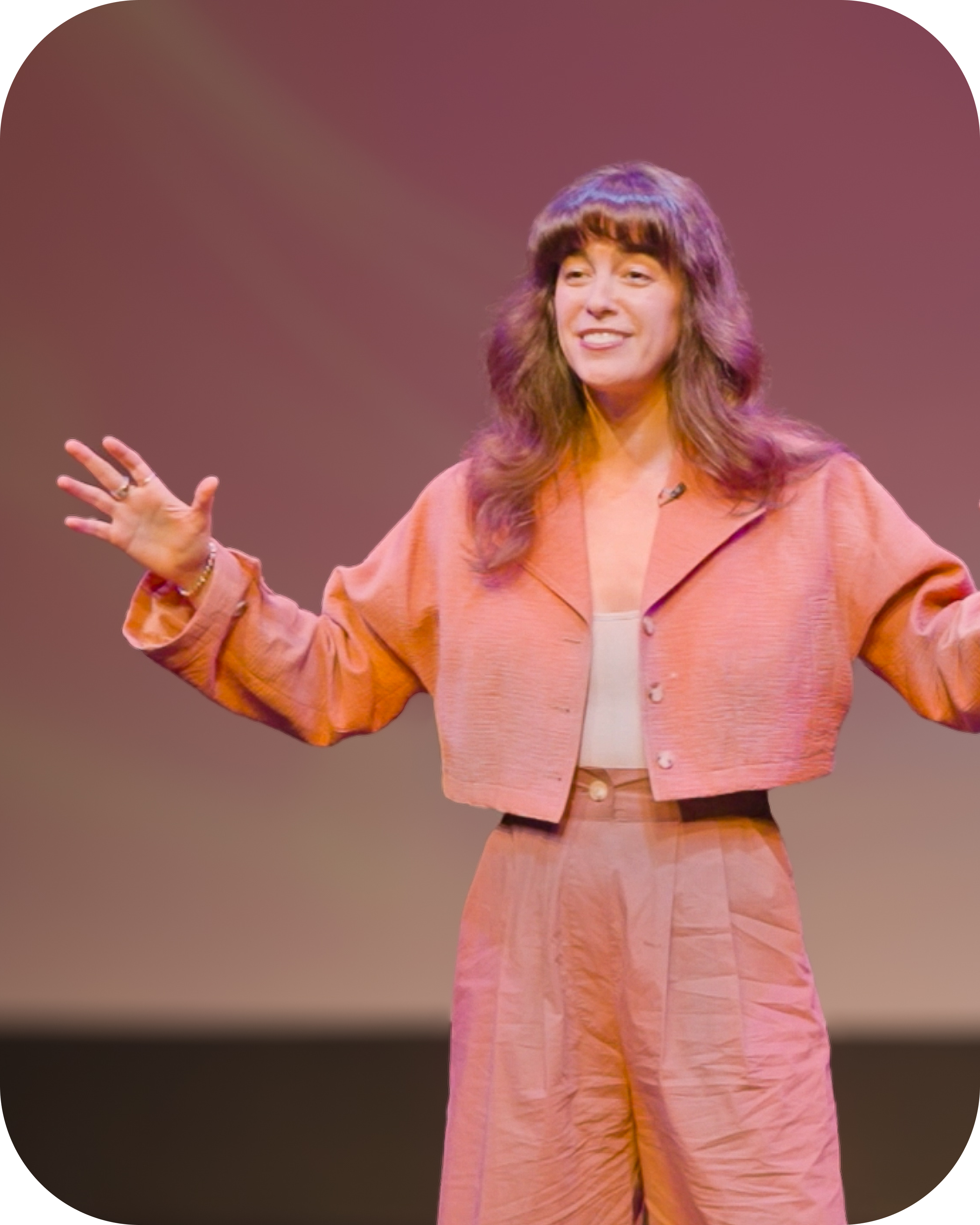
Rachel Weissman is a rare blend of business, craft, and wisdom.
She is a three-time tech entrepreneur, AI product design leader at Google and Salesforce, executive coach, certified meditation teacher, and academically trained artist.
She has shaped products used by billions and coached hundreds of high-profile leaders, from vast Fortune 500 companies to the smallest startups.
Her keynotes help leaders and teams build the internal capacity to thrive in the age of AI.
Keynote Topics
How Leaders Can Cut Through Noise, Reduce Overwhelm, Make Clearer Decisions, and Build the Internal Capacity to Thrive in the Age of AI
–
The Big Idea
Information used to be the advantage. Now it's free, infinite, and arriving faster than anyone can process it. The scarce resource is the capacity to interpret: to know what matters, what's real, and what to do next. That capacity can be developed, and those who develop it are the ones who will thrive and lead the new world.
–
Keynote Description
The average knowledge worker is now interrupted every two minutes by a meeting, email, or notification, and more than half of leaders say their work feels chaotic and fragmented (Microsoft Work Trend Index). Manager engagement just posted its steepest single-year drop on record (Gallup). The people expected to bring clarity to everyone else are the ones running lowest on it.
We've entered a new era. AI is commoditizing information, change is constant, and complexity is compounding faster than clarity. Many high performers are stuck in a widening gap between what they know and what they can actually hold. The question is no longer how do I stay ahead. It's how do I thrive when the ground keeps moving.
Rachel Weissman takes audiences beyond mindset into an honest, embodied relationship with capacity itself. She shows why the leaders who thrive now aren't the ones who know the most. They're the ones who can see most clearly. Real adaptation happens when mind, heart, and body come back into coherence, not through more effort but through a different way of paying attention.
Audiences leave with a framework they can name, practices they can actually use, and a felt experience of the shift rather than a description of it.
–
Key Audience Takeaways
- A new lens: Why interpretation, not information, is now a leader's greatest asset
- The 4 Cs: Center, Clarify, Connect, and Cohere, a four-part framework for moving from overwhelm to flourishing, and a way to identify which capacity is your current bottleneck
- Signal from noise: A practical method for telling what actually deserves your attention when everything is arriving at once
- Demand versus capacity: How to tell the difference between what's actually being asked of you and what you have to meet it, and between real constraints and self-imposed ones
- Micro-practices: Clearing mental noise, staying connected without drowning, and reading the body as early data, all short enough to use between meetings
- Actionable experiments: Specific ways to turn ordinary friction into a laboratory for capacity
–
Ideal For
Leadership summits, executive offsites, annual meetings, and conferences where the theme touches AI, change, resilience, or the future of work. Effective for senior leadership teams and full-organization audiences alike.
How Leaders Can Reduce Overwhelm, Prevent Burnout, Sustain Their Best People, and Build the Internal Capacity to Meet Constant Change
–
The Big Idea
Most resilience training teaches people to bounce back, which assumes the pressure is temporary. It isn't. Constant change is now the baseline condition of work, and the gap is no longer between effort and results. It's between what's being asked and what people have the capacity to hold. You don't close that gap by recovering faster. You close it by building a larger container.
–
Keynote Description
One in three employees say the pace of work over the past five years has made it impossible to keep up (Microsoft Work Trend Index). And the people leading them are carrying more, not less: leaders report significantly more daily stress, anger, sadness, and loneliness than the individual contributors they manage (Gallup). The strain is concentrated precisely where organizations can least afford it.
Your people aren't tired because they're working too hard. They're tired because the demand on them has outgrown their capacity to meet it, and no amount of time management closes that gap. AI has compressed timelines, flattened teams, and made constant change the water everyone is swimming in. What high performers need now isn't recovery. It's more room.
Rachel Weissman takes audiences beyond mindset into an honest, embodied relationship with capacity itself. She shows why the leaders who sustain aren't the ones who push hardest. They're the ones whose mind, heart, and body are working as one system. Real adaptation happens through a different way of paying attention, not through more effort.
Audiences leave with a framework they can name, practices they can actually use, and a felt experience of the shift rather than a description of it.
–
Key Audience Takeaways
- A new lens: Why the problem isn't workload alone, and what actually determines whether the same pressure depletes one person and expands another
- The 4 Cs: Center, Clarify, Connect, and Cohere, a four-part framework for moving from overwhelm to flourishing, and a way to identify which capacity is your current bottleneck
- Demand versus capacity: How to tell the difference between what's actually being asked of you and what you have to meet it, and between real constraints and self-imposed ones
- The body as data: Reading physical signals as early information rather than dismissing them until they become a crisis
- Micro-practices: Clearing mental noise, staying connected without drowning, and returning to center mid-day, all short enough to use between meetings
- Actionable experiments: Specific ways to turn ordinary friction into a laboratory for capacity
–
Ideal For
All-hands and full-organization gatherings, leadership summits, manager development programs, wellbeing and culture initiatives, and any event where burnout, retention, or sustainable performance is on the agenda.
How Leaders Can Reconnect Their People With Purpose, Restore Joy as a Performance Condition, Lead From Something Steadier Than Urgency, and Build the Internal Capacity to be a Light in the Age of AI
–
The Big Idea
A lighthouse doesn't chase ships. It stays put, stays lit, and lets everything else orient by it. Most leadership advice is about moving faster. Almost none of it is about what people are moving toward, or what happens to an organization when the answer quietly stops being anything at all. Purpose isn't a poster or an offsite exercise. It's a light that requires tending, and when it goes out the work still gets done, just without anyone in it.
–
Keynote Description
Only about one in five organizations has aligned human capability with organizational readiness, so high-value work surfaces in isolated pockets and never compounds (Microsoft Work Trend Index). Manager engagement just posted its steepest single-year drop on record, and leaders report significantly more daily stress, sadness, and loneliness than the people they manage (Gallup). The people responsible for keeping everyone else oriented are the ones who can least remember why.
Something specific is happening right now. AI is absorbing the parts of the job people found meaning in, timelines have compressed to the point where nobody looks up, and the daily experience of work has quietly narrowed to output. Teams aren't disengaged because they stopped caring. They're disengaged because the thing they once cared about got buried under the pace, and no one has asked about it in years. Ask a room full of high performers what first drew them to this work and watch how long the pause is.
Rachel Weissman treats joy not as a perk but as a signal, and one of the most accurate signals a leader has. She shows why the teams that sustain aren't the ones with the best incentives but the ones where something is still lit, and why that light is a condition you can actually design for rather than a mood you hope for. Purpose gets treated as a message to be communicated. It's closer to a fire that has to be tended, and the tending is the leadership work.
Audiences leave with a framework they can name, practices they can actually use, and a felt experience of the shift rather than a description of it.
–
Key Audience Takeaways
- A new lens: Why joy is diagnostic rather than decorative, and what its absence is telling you about your organization long before the engagement survey does
- The 4 Cs: Center, Clarify, Connect, and Cohere, a four-part framework for moving from depleted to lit, and a way to identify which capacity is your current bottleneck
- The lighthouse principle: Why steadiness orients people more powerfully than urgency, and how to become a fixed point others can navigate by
- Purpose as practice: How to recover the original why underneath the role, for yourself and for the people you lead, without it becoming an exercise nobody believes
- Micro-practices: Finding the live thread inside ordinary work, protecting what's still alive from the pace, and returning to what matters mid-day, all short enough to use between meetings
- Actionable experiments: Specific ways to make joy and meaning visible again in a team that has stopped mentioning either
–
Ideal For
All-hands and full-organization gatherings, culture and engagement initiatives, leadership summits, manager development programs, kickoffs and annual meetings where the theme is renewal or reorientation, and any event where retention, meaning, or morale is on the agenda.
How Leaders and Teams Can Protect Original Thinking, Work With AI Without Losing Their Signature, Turn Constraints Into Fuel, and Build the Conditions Where Breakthrough Becomes Reliable
–
The Big Idea
The old model of creativity was the lone genius waiting for inspiration. The new model is something else entirely: learning to build containers that allow intelligence to move through you. When AI can generate a thousand options in a second, ideation is no longer the scarce resource. What's scarce is the judgment to know which idea is alive, and the internal conditions that let original thinking surface at all.
–
Keynote Description
Only about one in five organizations has aligned human capability with organizational readiness. In the rest, high-value work emerges in isolated pockets but doesn't scale or compound (Microsoft Work Trend Index). The tools are not the bottleneck. The conditions are.
Most organizations have optimized away every condition that original thinking requires: unstructured time, tolerance for not knowing, the slowness that judgment needs. Then they wonder why the output is fluent and forgettable.
Rachel Weissman takes audiences beyond technique into an honest, embodied relationship with the creative process itself. She shows that breakthrough isn't a matter of having better ideas. It's a matter of capacity. Structure isn't the enemy of emergence. It's the condition for it.
Audiences leave with a framework they can name, practices they can actually use, and a felt experience of the shift rather than a description of it.
–
Key Audience Takeaways
- A new lens: Why the scarce resource is no longer ideas but discernment, and what that changes about how creative work gets led
- The 4 Cs: Center, Clarify, Connect, and Cohere, a four-part framework for moving creative work from forcing to flowing, and a way to identify where your process is currently stuck
- The container principle: Why constraints aren't blocks to creativity but the very thing that makes it possible, and how to design structures that invite emergence rather than control it
- Signal from noise: How to tell a genuinely alive idea from a merely plausible one, now the core creative skill in an age of infinite output
- AI as collaborator: Using generative and agentic tools without losing your creative signature or becoming dependent on the output
- A new relationship with not knowing: How to trust the process when you can't yet see the destination
–
Ideal For
Innovation summits, design and product organizations, marketing and creative teams, leadership offsites focused on transformation, and conferences where the theme touches AI, innovation, or the future of creative work.
Rachel's presentation blew everybody away. Really beautifully done.
— Sam, Associate Creative Director at Dame Creative
Rachel’s ability to create a transformative atmosphere is extraordinary.
— Joe, Head of Engineering at Humanity Labs
Rachel rewires your limiting beliefs as a leader.
— Mariya, Chief Technology & Porduct Officer at Metamaven
Rachel is a gifted speaker who weaves clarity into a deeply impactful experience.
— Eric, Co-Founder & Steward at Casalma
She's smart, creative, curious, detail-oriented, calm under fire, collaborative, and learning agile.
— Justin, Chief Design Officer at Atlassian
Are you a meeting professional?
Check out Rachel's further resources.
Book Rachel to Speak
The best keynotes don't end when the room clears. Rachel's audiences leave with capacity they keep building long after the event. Tell us about your event below.